
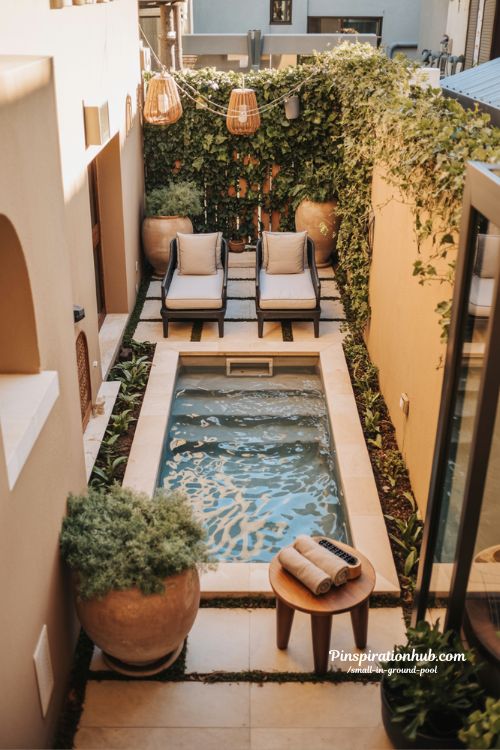
You look out at your backyard and think, “There’s no way a pool fits in there.” Trust me — that’s what almost everyone thinks before they actually look into it. Small inground pools have come a long way, and some of the most stunning backyard transformations happen in the tightest spaces. Whether you’re working with a narrow side yard, a compact urban lot, or just a modest suburban backyard, there’s a small inground pool design that can make it feel like a private resort.
- Small inground pools typically start at 10 × 16 feet and can comfortably fit 2–6 adults depending on the size you choose.
- Concrete, fiberglass, and vinyl liner are the three main material options — each with trade-offs for cost, access, and customization.
- A small pool generally costs $30,000 to $70,000 installed, and it’s easier and cheaper to maintain than a full-size pool.
Why a Small Inground Pool Might Be Exactly What Your Yard Needs
The average swimming pool sits around 600 square feet — roughly the footprint of a one-car garage. A small pool is anything under that, and it doesn’t mean you’re settling. It means you’re being smart about space. Common small inground pool sizes run from 10 × 16 to 12 × 24 feet. The 12 × 24 footprint is what most small-yard owners land on — it gives you enough length for a few strokes without swallowing the entire backyard.
One thing most people don’t think about upfront: you need more than just pool-sized square footage. Local building codes require setbacks from your property line, your house, and utility lines. Most municipalities want the water’s edge at least 4 to 10 feet from the boundary. Add fencing requirements and patio space, and you’re looking at a minimum of about 1,200 square feet of usable yard to make even a compact pool work. Below that, a plunge or cocktail pool style becomes your best bet.
| Pool Size | Best Use | Comfortable Capacity |
|---|---|---|
| 10 × 16 ft | Soaking, light play | 2–3 adults |
| 10 × 20 ft | Relaxation, family cooling off | 3–4 adults |
| 12 × 20 ft | Family use, modest entertaining | 4–5 adults |
| 12 × 24 ft | Popular all-around small build | 5–6 adults |
17 Small Inground Pool Ideas to Inspire Your Backyard
1. The Classic Plunge Pool for Hot-Climate Backyards
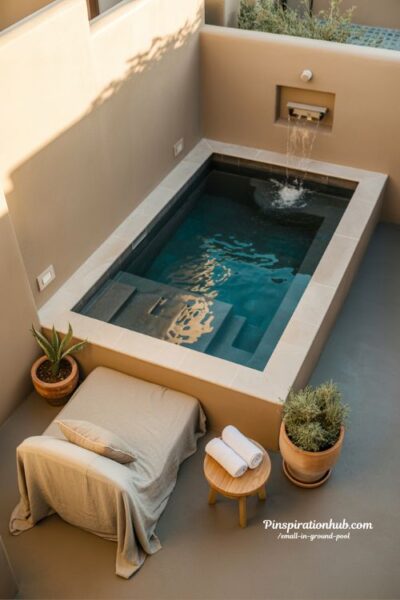
A plunge pool is small, deep, and built for actually cooling down — not just splashing around. Typical sizes run 8 to 12 feet wide and 12 to 20 feet long, going 4 to 8 feet deep. That extra depth keeps the water noticeably cooler on a blazing summer afternoon. Simple in design, a plunge pool fits beautifully into even the tiniest yard and becomes the quiet luxury feature you never knew you needed.
- Add a swim jet to make your plunge pool work double duty as a resistance-swimming exercise pool.
- Go deeper than 4 feet if your main goal is cooling off — deeper water stays cooler longer.
- Keep the design minimal around it; let the plunge pool be the focal point.
2. The Modern Rectangular Pool That Fits Into Any Yard
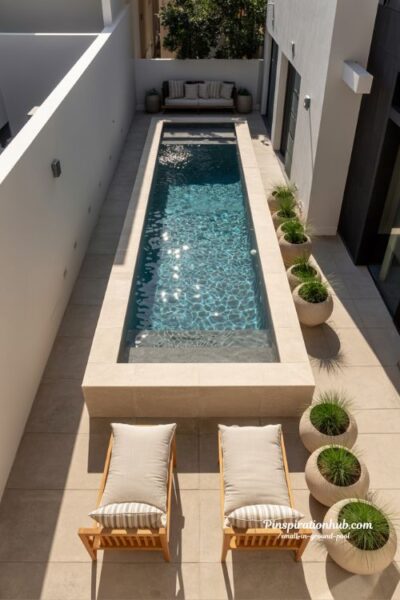
Clean lines, square corners, and a simple footprint — the modern rectangular pool gives you the most usable water area per square foot of any shape. It complements contemporary architecture beautifully and works especially well on narrow lots where a freeform shape would cut into swim space. This is the pool most small-yard designers recommend as a starting point because it’s practical and it looks genuinely stunning with the right coping.
- Pair with large-format stone coping and a matching concrete deck for a polished, high-end look.
- Square corners mean more water volume for the footprint — you’re not losing swim space to curves.
- Works well on tight urban lots because the shape is predictable and easy to plan setbacks around.
3. The Cocktail Pool for Lounging With Friends
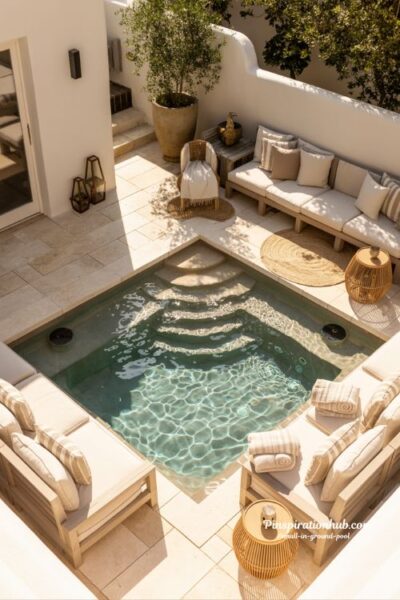
Sometimes you don’t want to swim — you want to sit in cool water, hold a drink, and actually talk to people. That’s what a cocktail pool (also called a spool or dipping pool) is built for. Shallow across the full bottom, usually 3 to 5 feet, it’s welcoming for all ages and prioritizes social lounging over laps. Built-in benches along the sides make it feel like a permanent outdoor living room.
- A uniform shallow depth makes entry easy — great for older adults and young children.
- Built-in bench seating is the cocktail pool’s defining feature; spec it into the design from the start.
- Consider adding jets to the bench area to turn your cocktail pool into a spool for year-round use.
4. A Spool That Runs Hot in Winter and Cool in Summer
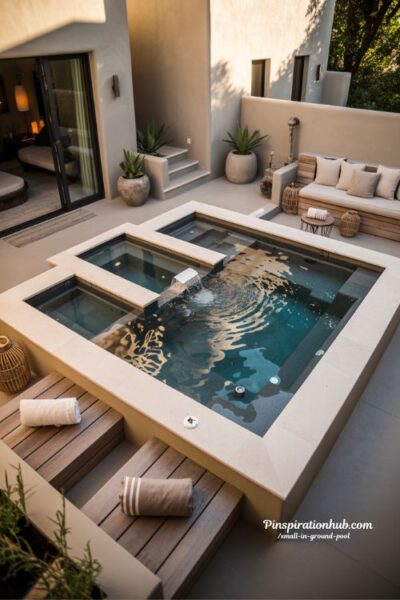
The spool is one of the smartest ideas in small backyard design — a pool-spa hybrid that gives you both experiences in one structure, usually around 10 × 14 feet. Run it cool in summer for a refreshing dip; heat it up in winter for a hot soak. It replaces both a pool and a hot tub, which is a real space win. The cost is higher than a basic plunge pool, but you’re buying two things in one footprint.
- A spool makes the most sense in climates where outdoor entertaining happens year-round.
- The heated jets also work for hydrotherapy — a bonus if sore muscles are a regular problem.
- Budget higher than a standard plunge pool; the heating system and jets add meaningful cost.
5. The Freeform Pool That Blends Into Your Landscape
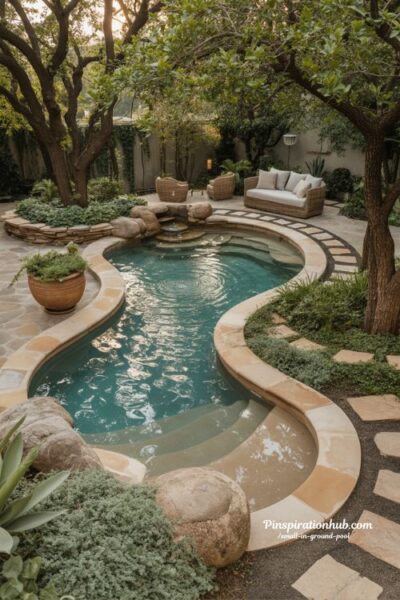
Curved, organic, and easy on the eye — a freeform pool mimics a natural body of water and works beautifully in wooded yards or backyards with mature trees and planted borders. The flowing shape creates nooks where you can tuck in a tanning ledge, a fountain, or a boulder feature. It’s less about swimming lengths and more about creating a retreat you want to spend hours in.
- Freeform shapes can wrap around existing trees or landscape features instead of removing them.
- The irregular outline makes a small pool feel larger than its actual footprint.
- Choose this style if relaxation is the priority — the shape isn’t ideal for active lap swimming.
6. The Sunken Pool With a Built-In Lounge Area
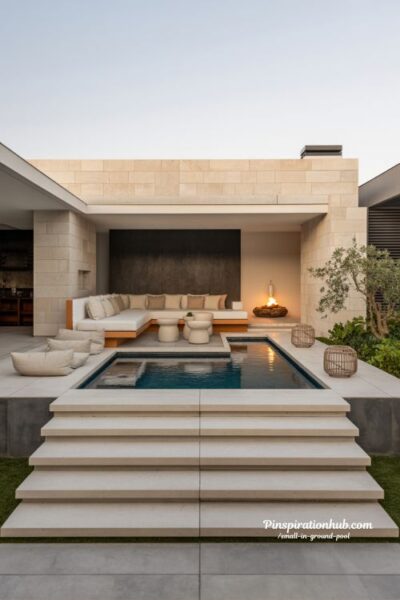
A sunken pool sits fully or partially below the surrounding deck, creating a tiered effect that adds real visual depth to a flat backyard. On a tight lot, this design makes the space feel intentional rather than cramped. Pair it with a sunken seating area or fire feature on one side and the whole backyard suddenly has structure. It’s one of the better ways to get a spa-like feel without adding footprint.
- Sunken designs work especially well when the pool is viewed from inside the house.
- A fire feature or outdoor seating pit on the sunken level makes the space useful all evening.
- Works on flat lots where other design drama is hard to create.
7. A Geometric Pool That Makes Use of Awkward Corners
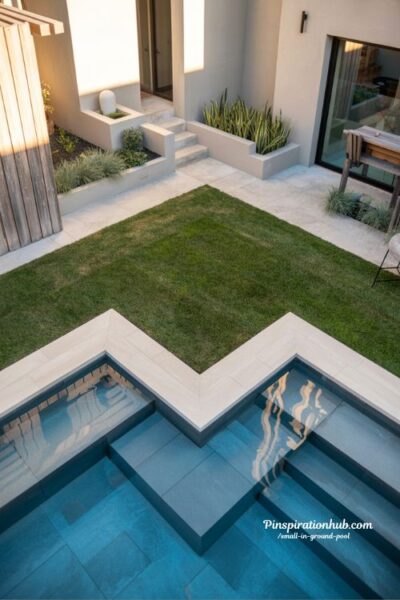
Square or rectangular pools are the obvious geometric choice, but L-shapes, hexagons, and custom angular shapes can do something even more useful — they can fit into the odd corners of your property that would otherwise just be wasted grass. A geometric pool in an awkward corner can free up the central yard for kids, pets, or outdoor dining. Concrete is the go-to material for unusual shapes because it’s built fully on site.
- Sketch your yard’s awkward corners before meeting with a designer — they’re often hidden opportunities.
- Geometric pools in corners can actually leave more central yard space free than a center-placed pool.
- Concrete is the best material when you need a truly custom angular shape.
8. The Turnkey Pool for a Fast, Budget-Friendly Build
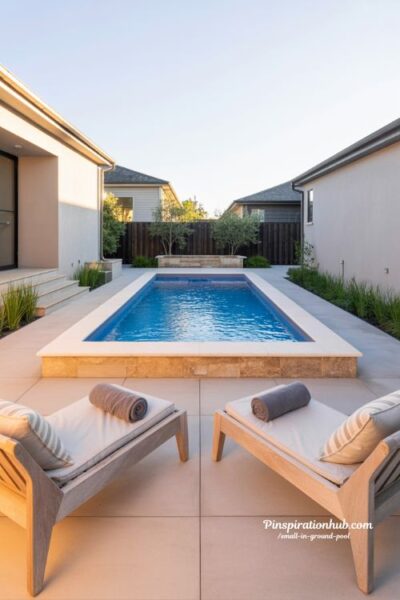
A turnkey pool is a packaged build — one contractor handles the pool, deck, fencing, and equipment under a single quote in a standard size. Customization is limited, but installation is faster and the total cost is usually lower because everything is pre-planned. For homeowners who want to be swimming by August without months of design back-and-forth, a turnkey pool at the 12 × 24 foot size is a genuinely smart choice.
- Ask for a turnkey quote early to understand your baseline cost before adding features.
- The speed advantage is real — turnkey builds often go from contract to swimming in weeks.
- Great for homeowners who want simplicity and a clean look without bells and whistles.
9. A Small Pool With a Tanning Ledge for Sun Lovers
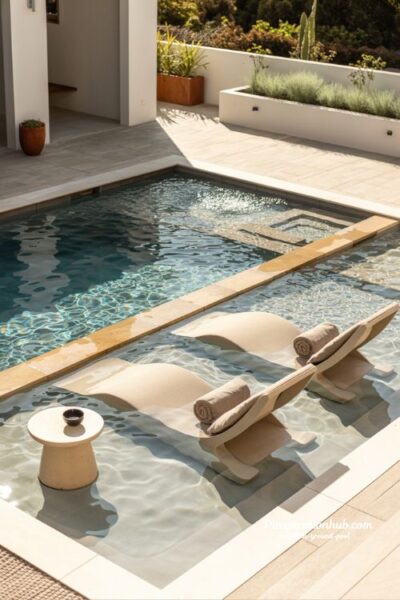
If your ideal pool afternoon involves lying in shallow water with sunglasses on while the kids splash nearby, a tanning ledge is the feature you’ve been missing. Also called a Baja shelf or sun shelf, it’s a shallow platform — usually just a few inches deep — that’s perfect for loungers, small children, and pets. It doesn’t add much to the overall footprint and dramatically increases how much the pool actually gets used.
- A tanning ledge works best when it runs along the sunniest edge of the pool.
- Add a bubbler on the tanning ledge for a fun water feature that costs around $450–$700.
- Great for families with young kids who want to be in the water but not in the deep end.
10. The Vanishing Edge Pool That Expands Your View
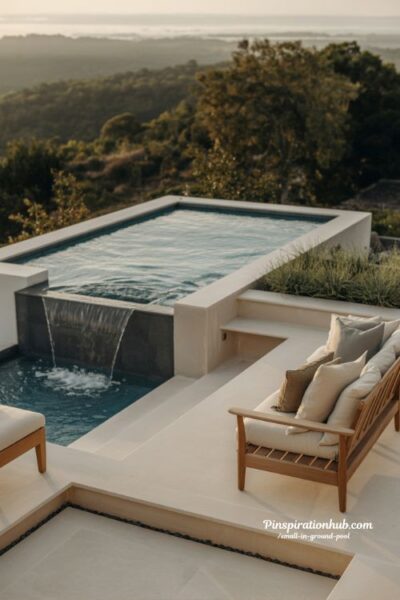
A vanishing edge — sometimes called an infinity edge — creates the illusion that the pool water blends seamlessly into the landscape or skyline beyond it. On a small pool, a single vanishing edge against a natural view can make the whole backyard feel three times larger than it actually is. It costs significantly more than a standard pool edge, but no single design feature transforms a compact space more dramatically.
- A vanishing edge works best when there’s a real view to borrow — trees, hills, a body of water.
- Budget for the additional engineering and catch basin that a vanishing edge requires.
- Even a modest view becomes dramatic when framed by a clean water edge at dusk.
11. A Small Geometric Pool With Waterline Tile
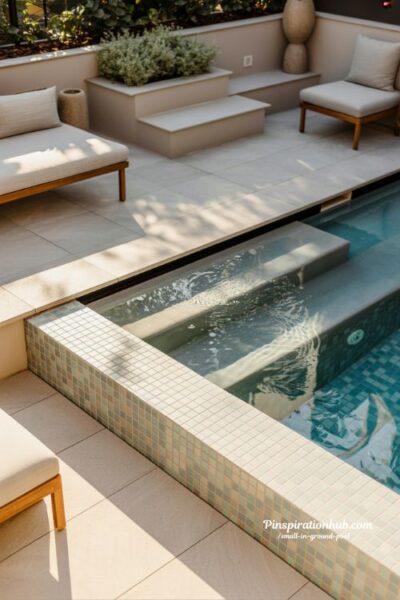
Waterline tile is one of the most underrated upgrades in pool design. It runs along the water line where the pool surface meets the coping, and the right tile can tie together your whole outdoor color scheme. Mosaic waterline tile, iridescent glass tile, or custom patterns all work beautifully on small pools where the shorter perimeter means the tile cost stays manageable. This is a high-impact, relatively affordable upgrade.
- Choose waterline tile in a color that connects to your coping or outdoor furniture palette.
- Glass tiles catch light differently throughout the day — the pool looks different at sunrise versus sunset.
- Budget the tile into the original build; adding it later is possible but more expensive.
12. A Lap Pool for Long Narrow Lots
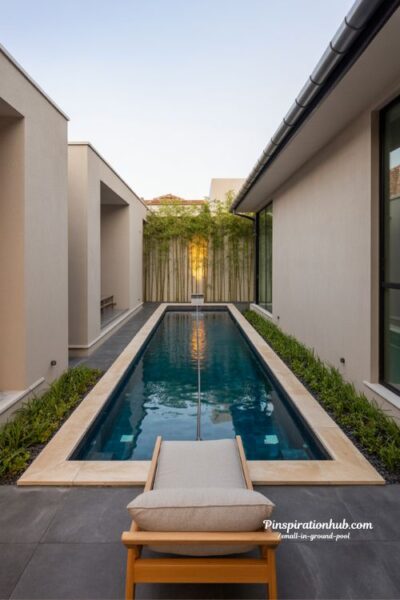
If your yard is narrow but long — a side yard, a linear lot behind a townhouse, or a long stretch alongside the house — a lap pool is worth serious consideration. Starting at 8 × 30 feet, a lap pool fits where a standard small pool cannot, and it trades entertaining capacity for genuine swimming distance. At a uniform 3.5 to 5 feet deep across the full length, it’s clean, simple, and satisfying to use.
- A counter-current swim jet or resistance system can turn a short lap pool into an endless pool experience.
- The linear shape can be screened with plantings along one side to create a private swim corridor.
- Lap pools work especially well on side-of-house lots that would otherwise sit unused.
13. Small Pool With a Rock Waterfall Feature
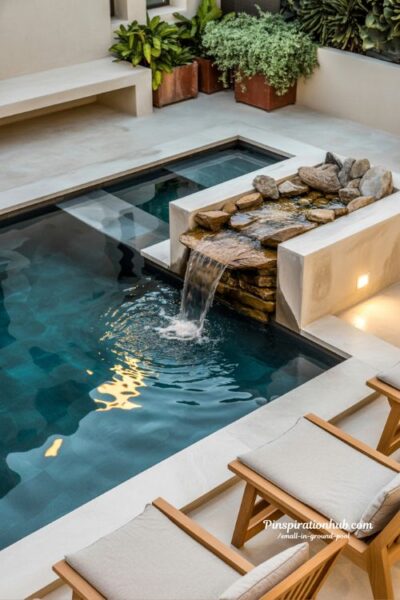
A rock waterfall connects your pool to the surrounding landscape in a way that makes the whole yard feel cohesive. On a small pool, a single well-placed waterfall feature adds sound, movement, and visual scale — it makes the pool feel like it belongs to a larger environment. The relaxing sound of falling water is genuinely hard to replicate with any other backyard feature, and it doesn’t require significant extra space.
- Plan waterfalls during the original build — adding them later is significantly more expensive.
- A simple standalone rock waterfall on one side works well even without a full landscaped backdrop.
- Pair with underwater lighting so the waterfall is visible and audible at night.
14. The Enclosed or Screened Small Pool
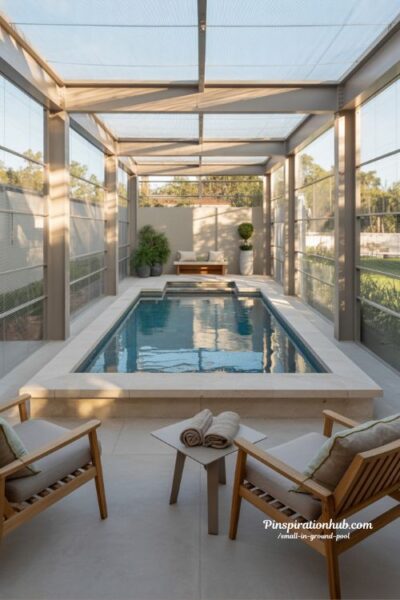
A pool enclosure extends your swim season without sacrificing natural light. Because you’re paying per square foot for the enclosure structure, a smaller pool is meaningfully cheaper to enclose than a full-size pool — making this an especially practical option for compact builds. Enclosures also dramatically increase privacy, reduce debris in the water, and reduce chemical use because the pool isn’t exposed to the elements.
- A screen enclosure reduces cleaning time significantly — leaves and debris stay out of the water.
- Look into retractable roof systems if you want the option of fully open-air swimming in good weather.
- Enclosures can also extend the swim season by several months in cooler climates.
15. Small Pool With Ambient and Underwater Lighting
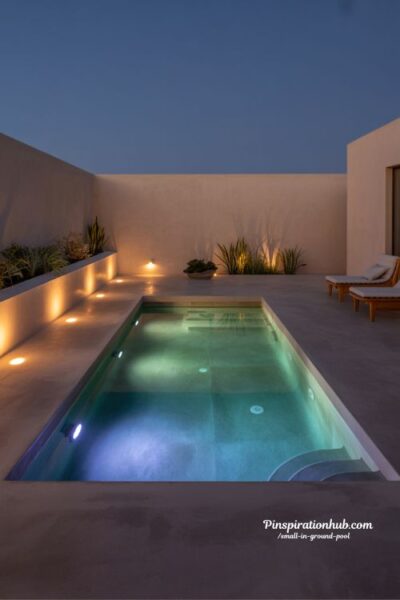
Lighting transforms a pool from a daytime feature into an all-night destination. LED color-changing underwater lights turn an evening swim into something genuinely magical, and well-placed hardscape spotlights around the pool perimeter make the space feel safe and welcoming for late-night entertaining. On a small pool, the investment is more manageable than on a full-size build, and the payoff is the same.
- Install multiple low-level lighting points rather than a single bright floodlight for a spa-like atmosphere.
- LED color-changing lights generally start around $900 each and must be installed during construction.
- Uplighting — fixtures that point upward onto plants or features — adds depth and warmth around the pool edge.
16. A Small Pool With a Built-In Spa or Attached Hot Tub
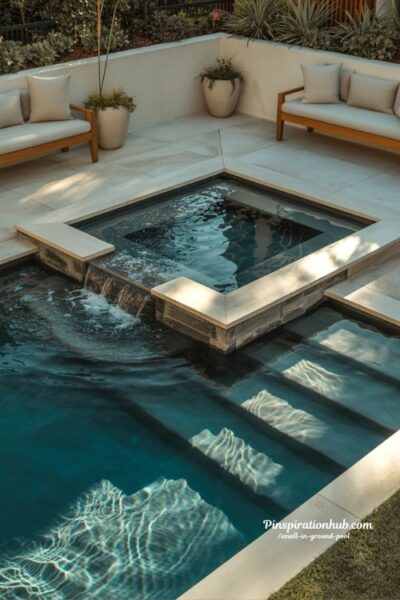
If you have room, combining a small pool with a spa is one of the best uses of a compact backyard. An attached spa adds roughly 6 to 8 feet to the overall footprint but gives you year-round water enjoyment. Connect the spa and pool with a spillway and you have movement, sound, and two temperatures available in the same outdoor space. If the footprint is truly tight, a spool structure handles both functions in one shell.
- A spillway between the spa and pool creates a visual and sound connection that feels natural.
- Integrated spa-pool designs heat more efficiently than separate structures.
- Confirm the combined footprint still meets your local setback requirements before committing.
17. The Pet-Friendly Small Pool With Tanning Shelf and Gentle Entry
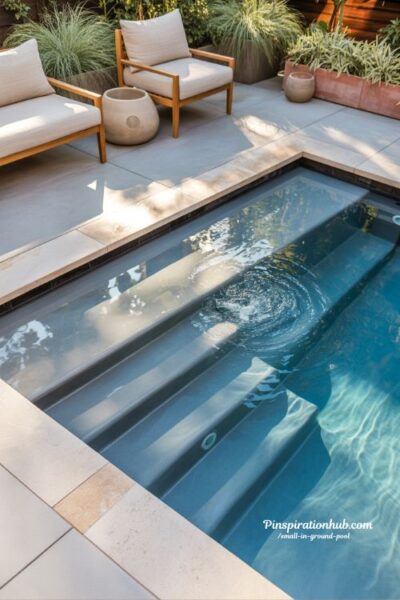
If your dog considers the backyard their personal domain, designing a pet-friendly pool from the start saves a lot of headaches later. A wide tanning ledge provides a safe walking surface for dogs entering and exiting the water. Fiberglass pool surfaces with a gel coat finish resist scratching from pet claws better than other materials. A gradual beach entry on one side makes it accessible for larger dogs and also adds charm to the overall design.
- Fiberglass pools are the most pet-friendly surface option thanks to their scratch-resistant gel coat.
- A wide tanning ledge lets dogs wade in gradually instead of jumping from the edge.
- Make sure the pool ladder or steps also work for pets — or add a dedicated pet ramp.
Quick Comparison: Small Inground Pool Types at a Glance
| Pool Type | Best For | Depth | Budget Level | Yard Type |
|---|---|---|---|---|
| Plunge Pool | Cooling off, exercise | Deep (4–8 ft) | Mid | Any |
| Cocktail Pool | Socializing, lounging | Shallow (3–5 ft) | Mid | Any |
| Spool | Year-round use | Mixed | High | Any |
| Lap Pool | Swimming exercise | Uniform (3.5–5 ft) | Mid | Narrow/long |
| Turnkey Pool | Fast, simple build | Varies | Budget | Standard |
| Freeform Pool | Natural aesthetics | Mixed | Mid-High | Wooded, irregular |
| Geometric Pool | Modern homes, corners | Varies | Mid | Compact, urban |
| Vanishing Edge | View lots, drama | Mixed | High | View-facing |
FAQ
What is the smallest size for an inground pool?
Most small inground pools start at 10 × 16 feet for practical use. Below 10 × 14 feet, the build functions more as a plunge or cocktail pool than a swim pool. Concrete pools can technically go smaller since they’re built on site, but ultra-small pools work best for one or two adults who want a private soaking space rather than a family swim feature.
How much does a small inground pool cost to install?
A small inground pool generally runs $30,000 to $70,000 installed. Vinyl liner pools are the most affordable starting point, often around $30,000 for a basic build. Fiberglass pools typically run $40,000 to $70,000. Concrete starts around $50,000 and climbs quickly with custom shapes and finishes. Access challenges — cranes, narrow gates, retaining walls — can add meaningfully to any of those numbers.
Are small inground pools easier to maintain?
Yes, genuinely. A smaller pool means less surface to vacuum, less water to chemically treat, and lower energy costs to heat. A compact 7,500-gallon pool needs roughly a third of the chlorine a full-size pool uses. The one caveat: small pools react faster to chemistry changes, so regular testing matters more — a few warm days and heavy bather load can shift the balance quickly.
Does a small inground pool add home value?
In warm-climate markets where outdoor living is a strong selling point, a well-built small inground pool typically returns 5 to 8 percent of home value. In cooler regions, the return is often lower. The key is that a small pool needs to be well-designed and well-maintained — a dated or poorly installed pool can actually reduce buyer interest rather than increase it.
Do small inground pools require a fence?
Yes. Almost every U.S. jurisdiction requires a barrier around any inground pool deeper than 24 inches, regardless of size. Most codes require a fence at least 48 inches tall with self-closing, self-latching gates. The fence often needs to sit a minimum distance from the water’s edge, which is one more reason to confirm your local setbacks and fencing rules before finalizing your pool size and position.
Can I add a swim jet to a small inground pool?
Yes, and it’s one of the smartest upgrades for a small pool. A counter-current swim jet lets you swim in place against a steady current, turning even a 10 × 16 plunge pool into an effective exercise pool. Jets need to be planned and installed during construction, so raise it early with your designer or builder if resistance swimming is part of your goal.
What pool material is best for a small backyard?
It depends more on your yard’s access than on personal preference. Fiberglass is lowest-maintenance but needs crane access and a clear delivery path — tight urban lots often rule it out. Vinyl liner is easier to install in tight spaces and costs less upfront but needs liner replacement every 5–10 years. Concrete works in any access situation and allows any custom shape, but costs more and requires more maintenance long-term.