
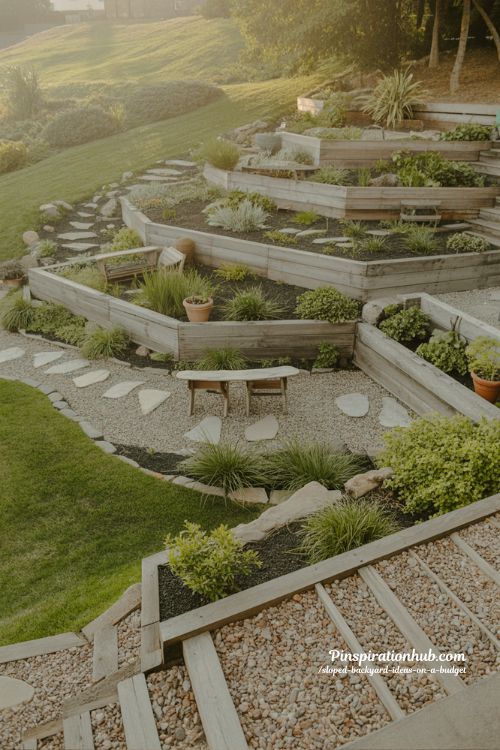
If you’ve ever stood at your back door staring down a slope that feels more like a landscaping problem than a backyard, you’re not alone. Most homeowners with sloped yards assume the only fix involves a contractor and a terrifyingly large invoice — think $5,000 to $15,000 for professional retaining walls alone. Here’s the thing: that’s rarely true. A sloped backyard, when you stop fighting it and start working with it, can become one of the most visually stunning outdoor spaces on the block. The elevation changes that feel like a headache right now? They’re actually your secret advantage for creating layered gardens, natural water features, and multi-level living spaces that flat yards simply can’t pull off.
- Groundcover plantings can stabilize a slope for under $300 — a fraction of the cost of hardscape alternatives.
- DIY terracing with railroad ties or reclaimed materials runs $500–$2,000 compared to $3,000–$15,000 for professional installs.
- Native plants and ornamental grasses, once established, need almost zero maintenance or watering.
Why a Sloped Backyard Is Worth Landscaping
Sloped terrain naturally solves one of the most common flat-yard problems: drainage. Rainwater flows away from the house rather than pooling against your foundation. The built-in elevation also creates natural planting zones — different microclimates at different heights — which opens up a wider range of plants than a flat lot ever could.
The real challenge isn’t the slope itself. It’s erosion and the lack of usable flat space. Tackle those two things with smart, affordable strategies, and everything else opens up. Here’s a quick comparison of what the main approaches cost so you can plan around your actual budget.
| Method | DIY Cost Range | Professional Cost | Difficulty |
|---|---|---|---|
| Groundcover planting | $200–$400 | $800–$2,000 | Easy |
| Railroad tie terraces | $500–$1,000 | $3,000–$6,000 | Moderate |
| Stone dry-stack walls | $400–$900 | $5,000–$10,000 | Moderate |
| Gabion basket walls | $500–$1,000 | $4,000–$8,000 | Moderate |
| Wildflower meadow | $50–$150 | $600–$1,500 | Easy |
| Native plant stabilization | $400–$600 | $1,500–$3,000 | Easy |
17 Sloped Backyard Ideas on a Budget
1. Dense Groundcover to Stop Erosion Fast
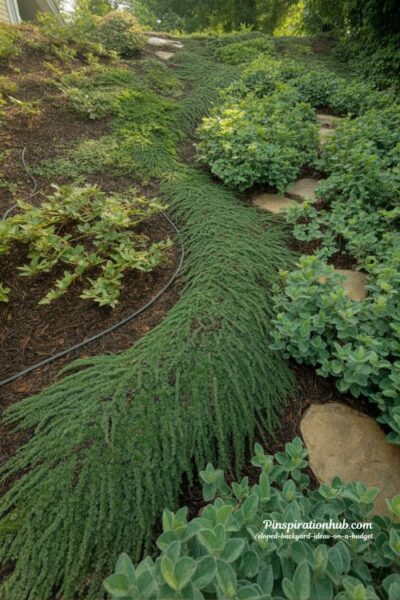
Creeping juniper, vinca, and pachysandra are the unsung heroes of slope landscaping. These fast-spreading groundcovers stabilize soil with extensive root systems, cost just $2–$4 per plant in bulk flats, and completely eliminate the need to mow a dangerous hillside. Plant them along the slope’s contour lines rather than straight up and down — this simple trick prevents water from channeling into trenches and washing everything away.
- Buy in bulk flats rather than individual pots — you’ll pay half the price.
- Choose species rated for your USDA hardiness zone to avoid replanting.
- Mulch between plants at planting time; it suppresses weeds while the groundcover fills in.
2. Railroad Tie Retaining Terraces on a Shoestring
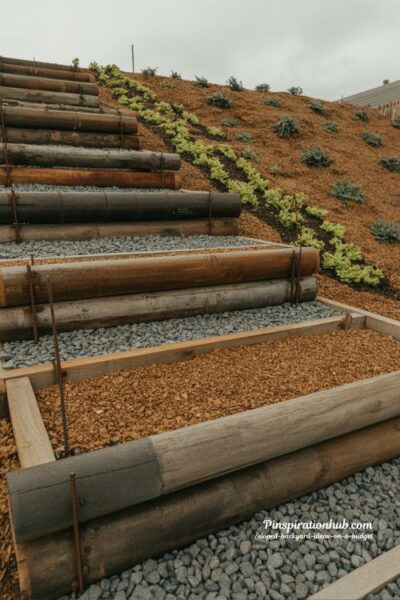
Used railroad ties from salvage yards run $10–$20 each — compared to $30–$50 for new landscape timbers — and they handle serious soil retention without drama. Their weathered, rustic look ages naturally into the landscape. Stack them along contour lines to create level planting beds out of what was previously unusable hillside. Drive rebar through drilled holes deep into the slope to anchor them, and step each course back slightly for long-term stability.
- Source ties through local salvage yards, Craigslist, or Facebook Marketplace for the best prices.
- Pre-drill rebar holes before positioning ties to save yourself a lot of frustration.
- Fill behind each tier with gravel before adding topsoil — drainage is everything on slopes.
3. Native Plants That Stabilize Without Any Help
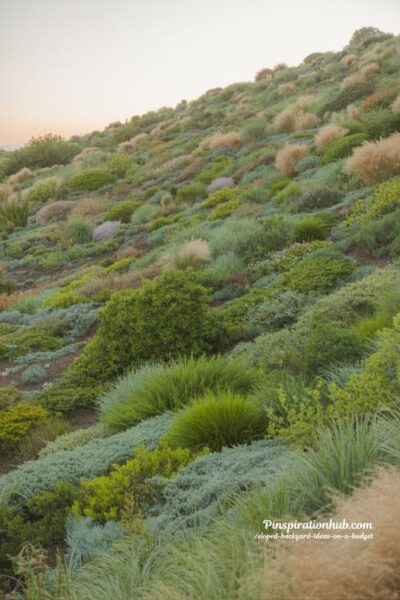
Native grasses, shrubs, and perennials adapted to your region’s hillside ecosystems do the stabilization work entirely on their own once established. No irrigation system, no soil amendments, no expensive maintenance schedule. At $5–$15 per plant from a native nursery, a complete slope planting costs $400–$600 total — and after the first year, you can essentially ignore it. Research what grows wild on hillsides in your region; those are exactly the plants you want.
- Visit your local native plant society for free advice and often deeply discounted plants.
- Plant in fall when cooler temperatures reduce transplant stress and roots establish faster.
- Mix species with different root depths for layered, more effective erosion control.
4. Free Fieldstone Dry-Stack Walls That Last Decades
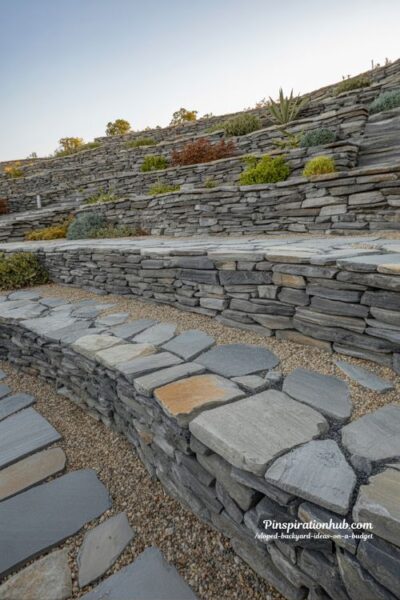
Collecting fieldstone from local properties (often free if you haul them yourself) or buying broken concrete — called urbanite — for $20–$40 per ton creates dry-stacked retaining walls without a single bag of mortar. These gravity-dependent structures use weight and careful fitting to stay put. They’re permanent, they drain naturally between the stones, and they look like they belong on the land in a way that poured concrete never does.
- Start with your largest, flattest stones as foundation courses — stability lives at the bottom.
- Build lower terraces first, working uphill so you’re not undermining finished work above.
- Backfill with gravel immediately after each course to lock everything in place structurally.
5. Mulched Switchback Pathways That Cost Almost Nothing
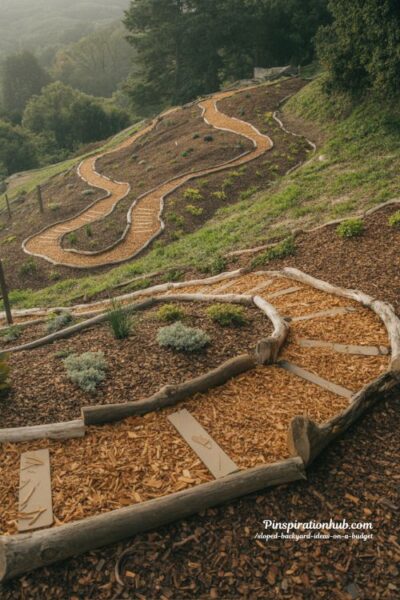
A steep slope becomes completely navigable when you zigzag a switchback path across it rather than charging straight up the incline. Hardwood mulch or wood chips at $30–$50 per cubic yard cover substantial pathway lengths for under $200 total. Edge the path with salvaged branches or old timber offcuts to define the route and contain the mulch. This isn’t just practical — it’s one of the most visually charming things you can do to a slope.
- Lay cardboard underneath the mulch layer first; it suppresses weeds for a full season.
- Keep path grades at 10% or less for comfortable, safe walking without slipping.
- Replenish mulch every spring as it decomposes — it feeds the soil as it breaks down.
6. A Gravity-Fed Water Feature That Runs Itself
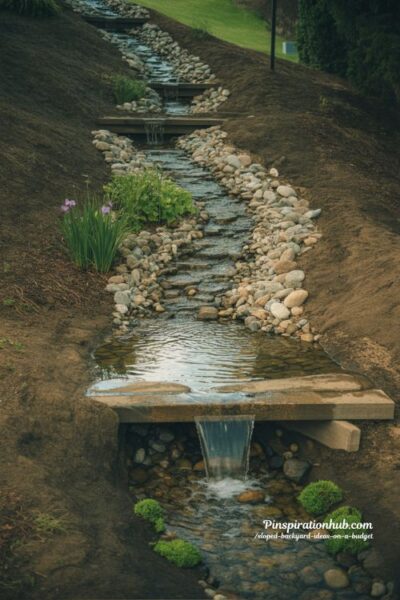
A slope is literally a pump you don’t have to pay electricity for. Directing natural drainage into a boulder-lined stream or cascading waterfall costs $300–$800 in materials and creates something genuinely beautiful while managing runoff in a controlled way. Position the feature along the slope’s natural drainage path — the water wants to go there anyway — and use stones to direct flow artistically, adding small pools or basins at intervals to slow the velocity.
- Use a pond liner under gravel to keep water in the stream rather than soaking into the ground.
- Choose rounded river rocks rather than angular quarry stone for a natural, stream-bed look.
- Add moisture-loving plants like iris or cardinal flower along the edges at no extra cost.
7. Terraced Vegetable Beds That Feed Your Family
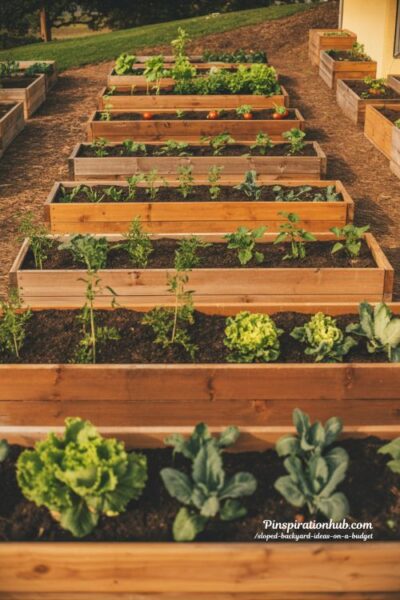
Untreated cedar or pine boards at $50–$150 per 4×8 bed turn a useless hillside into a productive food garden. Build the beds perpendicular to the slope following the natural contour lines, stepping each one up the hill so you can reach every bed comfortably from below. The excellent drainage that slopes naturally provide is actually ideal for vegetables, which hate wet roots. This is one of the few landscaping projects that genuinely pays you back.
- Orient beds east-to-west so plants on upper terraces don’t shade lower ones.
- Use a spirit level religiously — even a slight tilt causes water to pool on one side.
- Fill beds with a 60/30/10 mix of topsoil, compost, and coarse sand for perfect drainage.
8. A Wildflower Meadow That Mows Itself (Basically)
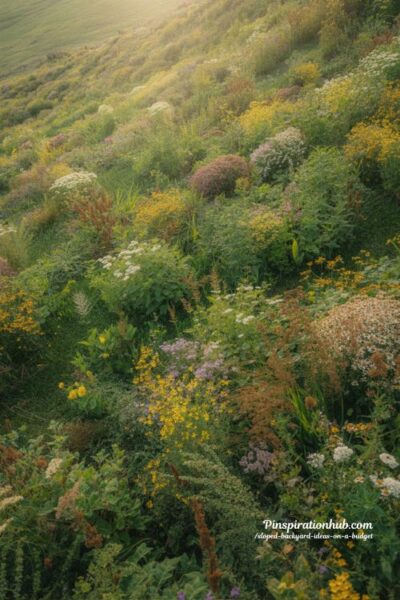
Regional wildflower seed mixes cost $50–$100 per quarter-acre, establish deep roots that hold soil beautifully, and require no mowing once mature. Prepare the slope by removing existing vegetation, broadcast seed in fall or early spring, water until plants establish, and then step back. The meadow handles itself on rainfall alone after that first season. It also brings in pollinators, looks genuinely stunning in bloom, and eliminates the real safety hazard of mowing a steep slope.
- Choose a mix specifically labeled for slopes or erosion control — not all wildflower mixes qualify.
- Sow at twice the recommended rate on steep slopes; some seed will wash before germinating.
- Resist the urge to mow in year one — the plants need height to establish their root systems.
9. Repurposed Pallets for Ultra-Budget Retaining
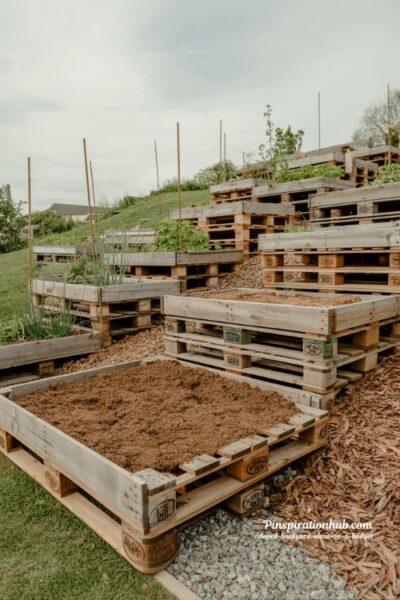
For gentle slopes with small grade changes, free wooden pallets from businesses create surprisingly effective makeshift retaining walls when properly anchored. The total investment is $10–$20 in anchoring hardware. Fill pallet voids with landscape fabric to prevent soil washing through, anchor securely with rebar or timber stakes, and plant in front to soften the look. This isn’t a long-term solution for steep slopes, but it buys you time while you plan and save for something more permanent.
- Ask hardware stores, garden centers, and warehouses — they often give pallets away happily.
- Choose heat-treated pallets (marked HT) rather than methyl bromide-treated ones (MB).
- Plant climbing or trailing plants in front within the first season to start hiding the structure.
10. Ornamental Grasses That Move With the Wind
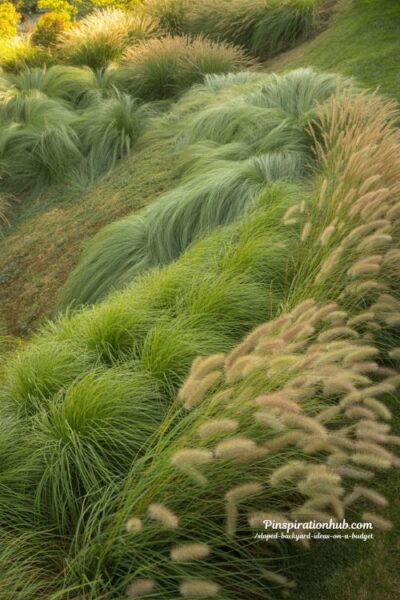
Miscanthus, fountain grass, and native switchgrass cost $8–$20 per plant, thrive on the excellent drainage of slopes, and create movement and texture that no hardscape can replicate. Their fibrous root systems work constantly to stabilize soil at multiple depths. Space them according to their mature size, let them spread naturally over a few seasons, and you end up with a slope that looks designed rather than contained — all without ongoing watering once established.
- Cut grasses back to about 4 inches in late winter before new growth begins.
- Mix warm-season and cool-season varieties for interest across more of the calendar year.
- Leave seedheads through winter — they feed birds and look genuinely beautiful in frost.
11. Strategic Boulder Placement for Natural-Looking Structure
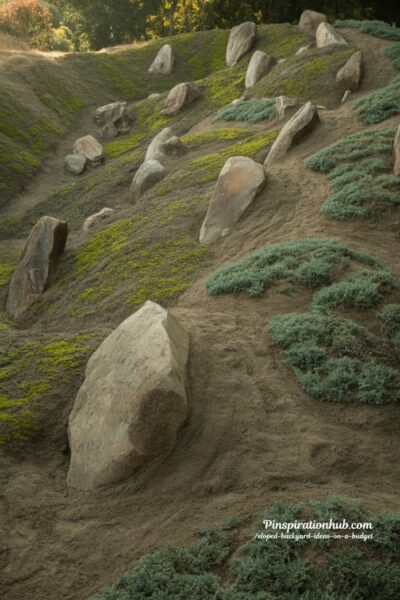
Partially buried boulders positioned in odd-numbered clusters look like natural outcroppings rather than obviously placed rocks, and they do real work holding soil in place. Local quarries deliver reasonably sized specimens for $100–$300 each. Bury at least one-third of each boulder below grade so it reads as emerging from the earth rather than sitting on top of it. Cluster boulders at natural gathering points — slope transitions, path junctions, planting bed corners.
- Mark the position with spray paint before digging; repositioning a 300-pound boulder is miserable.
- Plant low groundcover or ornamental grasses around boulders to integrate them with the slope.
- Choose stone native to your region — it’ll look like it was always there rather than imported.
12. Timber Steps That Make the Whole Slope Usable
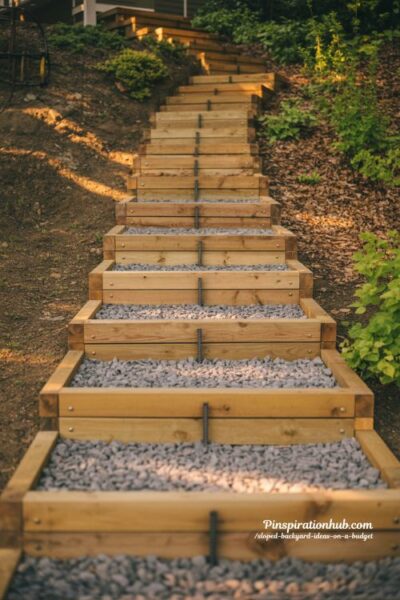
Treated 6×6 landscape timbers at $15–$25 per 8-foot length create substantial, long-lasting steps for under $300 total in most residential applications. Secure each timber with rebar stakes driven through drilled holes, backfill with compacted gravel for drainage, and space steps at a comfortable stride length. This single improvement dramatically increases how often and how safely you actually use a sloped yard — which makes every other improvement you add more worthwhile.
- Set each step slightly lower at the front edge — a 1–2% back-tilt drains water away naturally.
- Use 12-inch-deep treads rather than 8-inch; the extra depth feels more confident underfoot.
- Anchor the lowest timber especially well — it bears the most pressure from foot traffic above.
13. Gabion Baskets for Modern Industrial Style
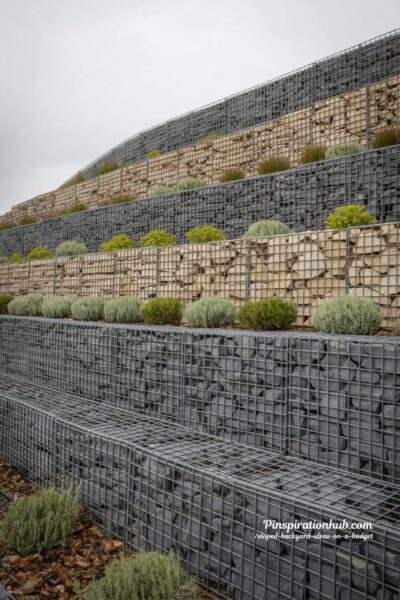
Wire cages filled with rocks at $30–$60 per basket create retaining walls with a contemporary industrial-chic aesthetic, strong structural integrity, and excellent natural drainage. DIY gabion walls for a typical residential slope run $500–$1,000 — versus $5,000+ for masonry equivalents. Rocks can come from the slope itself, from local properties, or from quarry waste. Stack and secure cages per manufacturer instructions and fill with uniform stones for a clean look or mixed materials for something more textured.
- Use galvanized or PVC-coated gabion wire for significantly longer lifespan outdoors.
- Fill in layers of 6–8 inches, tamping gently as you go to prevent visible voids later.
- Plant trailing sedum or thyme in the top course — roots eventually grow through and anchor everything.
14. Cascading Junipers for Zero-Maintenance Coverage
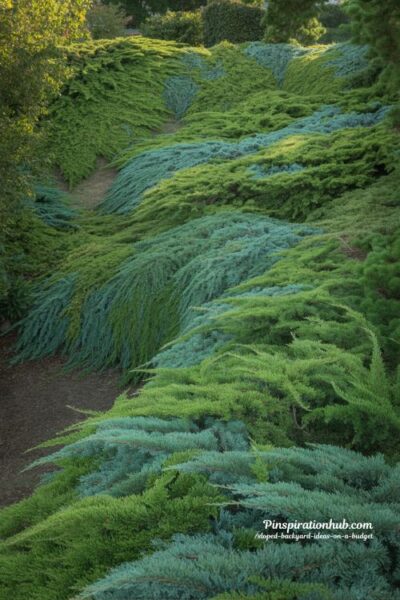
Spreading junipers cost $15–$30 per plant, spread several feet wide, and create complete, permanent erosion control within 2–3 years of planting. Their dense blue-green foliage looks good year-round, naturally crowds out weeds, and requires zero intervention once established. Plant with spacing that accounts for mature spread — it looks sparse at first, but patience is all this approach needs. For busy homeowners who want to solve the slope problem once and genuinely never think about it again, this is the answer.
- Water weekly for the first full summer, then step away and let them establish on their own.
- Avoid planting near the home’s foundation — spreading junipers need room to do their thing.
- Mix ‘Blue Rug’ (very low) with ‘Bar Harbor’ (slightly taller) for layered, natural-looking coverage.
15. No-Mow Grass Alternatives That Stay Green Naturally
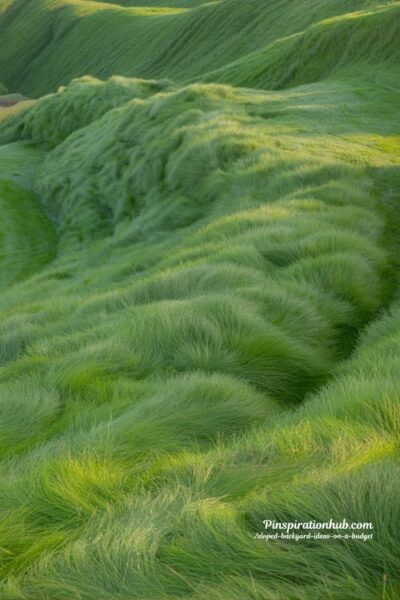
Seeding a slope with buffalo grass or fine fescue blends costs $100–$200 per 1,000 square feet and permanently eliminates the real danger of mowing a steep incline. These specialty grasses grow slowly, rarely need cutting, and handle drought far better than conventional turf. The long-term savings in time, fuel, and equipment wear make the seed investment genuinely worthwhile — not just as a safety decision but as a financial one over any reasonable time horizon.
- Overseed bare patches in fall for best germination rates on cool-season fescue varieties.
- Avoid high-nitrogen fertilizer; it pushes fast growth and defeats the purpose of a slow-growing blend.
- Allow the grass to reach 4–5 inches before the first mow to encourage deep root development.
16. Planting Pockets in Retaining Walls for Living Structure
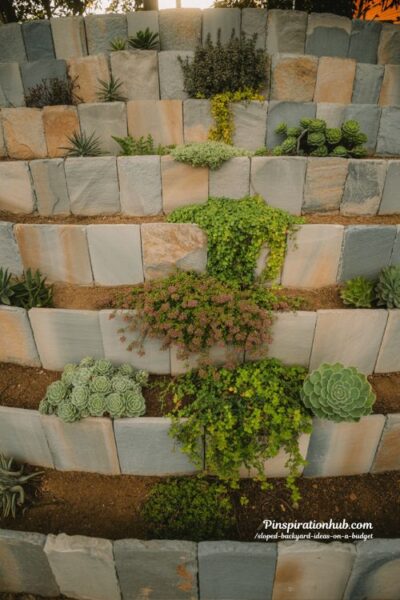
Whatever retaining material you use — stone, brick, timber, block — leaving intentional planting pockets between units turns a purely functional wall into a living garden feature. This adds zero material cost while softening the hard edge of the structure entirely. Fill pockets with quality potting mix and plant trailing species like sedum, creeping thyme, or alpine strawberry. Over one season, the wall disappears into the planting, and what you’re left with looks completely intentional and genuinely beautiful.
- Use plants with shallow root systems in wall pockets — deep-rooted plants can destabilize the wall.
- South-facing wall pockets stay drier; choose drought-tolerant succulents there specifically.
- Water pockets by hand in the first season until plants establish enough to find their own moisture.
17. A Simple Carved Terrace for Outdoor Seating
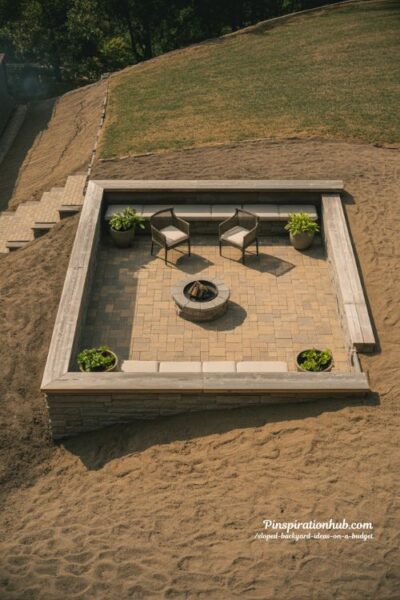
Carving a single level seating area into a slope and containing it with a timber or stacked-stone retaining edge costs $200–$400 in materials — and turns an unusable hillside into an actual outdoor room. Compact the carved soil thoroughly before laying any pavers to prevent future settling. Add a small paver patio, a couple of chairs, and a fire pit, and you’ve created the kind of space that makes the slope feel like an intentional design choice rather than an inherited problem you’re still fighting.
- Place the seating area where it captures the best view down the slope or into the yard.
- Slope the patio surface 1% away from any adjacent structure to direct rainwater outward.
- Surround with container plantings at first; permanent in-ground planting can come later when the budget allows.
Budget and Style Comparison: All 17 Ideas at a Glance
| Idea | Approx. DIY Cost | Best For | Difficulty | Maintenance |
|---|---|---|---|---|
| Groundcover planting | $200–$400 | Erosion control | Easy | Low |
| Railroad tie terraces | $500–$1,000 | Usable planting beds | Moderate | Low |
| Native plants | $400–$600 | Long-term stability | Easy | Very Low |
| Fieldstone dry-stack | $400–$900 | Permanent walls | Moderate | Very Low |
| Mulched switchbacks | Under $200 | Access and aesthetics | Easy | Low |
| Gravity water feature | $300–$800 | Drainage + beauty | Moderate | Low |
| Vegetable terraces | $150–$450 | Productive gardening | Moderate | Medium |
| Wildflower meadow | $50–$150 | Naturalistic look | Easy | Very Low |
| Pallet retaining | Under $50 | Temporary fix | Easy | Medium |
| Ornamental grasses | $200–$400 | Movement + texture | Easy | Low |
| Boulder placement | $100–$300/ea | Focal points | Moderate | None |
| Timber steps | Under $300 | Slope access | Moderate | Low |
| Gabion baskets | $500–$1,000 | Modern aesthetic | Moderate | None |
| Cascading junipers | $200–$500 | Permanent coverage | Easy | None |
| No-mow grasses | $100–$200 | Safety + ease | Easy | Very Low |
| Wall planting pockets | $0 extra | Softening hard edges | Easy | Low |
| Carved seating terrace | $200–$400 | Outdoor living | Moderate | Low |
FAQ
What is the cheapest way to landscape a sloped backyard?
Wildflower seeding runs $50–$150 for a quarter-acre and requires almost no labor beyond initial prep. Groundcover plantings come in second at $200–$400 for average slopes. Both approaches use the plants themselves to control erosion rather than expensive hardscape structures. If your slope is gentle, either of these alone may be all you need.
Can I terrace a steep backyard without hiring a contractor?
Yes — plenty of homeowners do it successfully with railroad ties, timber sleepers, or stacked stone. The key steps are marking your terrace lines with stakes and string, digging a shallow ledge, installing your retaining edge, backfilling with gravel for drainage, and then planting. For slopes steeper than about 2:1, it’s worth getting a professional opinion before you build anything structural.
How do I prevent erosion on a sloped backyard on a budget?
The layered approach works best: install erosion mat or mulch for immediate protection while fast-growing groundcovers establish their root systems underneath. Biodegradable jute or coir matting costs $75–$150 per roll, holds soil while seeds germinate, and then decomposes naturally — so you never have to remove it. Add dense shrubs or ornamental grasses for long-term stability.
What are the best plants for a sloped backyard on a budget?
Creeping juniper, vinca, and pachysandra are the most affordable and fastest-establishing groundcovers for erosion control. Native grasses and perennials adapted to your region cost $5–$15 each and need almost no maintenance once established. Ornamental grasses like switchgrass or fountain grass add visual interest while doing real structural work holding soil in place.
How do I make a sloped backyard more usable without spending a fortune?
Start with one carved terrace — just enough flat space for a small seating area — and work outward from there as budget allows. A single level zone transforms how you actually use the yard day-to-day. Add mulched switchback paths so the whole slope becomes accessible, then layer in plantings over the next season or two. Phased improvements spread cost over time without sacrificing results.
Do I need retaining walls for a sloped backyard?
Not necessarily. Gentle to moderate slopes can be fully stabilized with groundcovers, native plants, ornamental grasses, and strategic boulder placement alone — no hardscape required. Retaining walls become necessary when you want level planting beds or seating areas on steeper grades, or when erosion is severe enough that plants alone can’t get established. If the slope is gradual, start with plants and see how far they take you before investing in walls.