
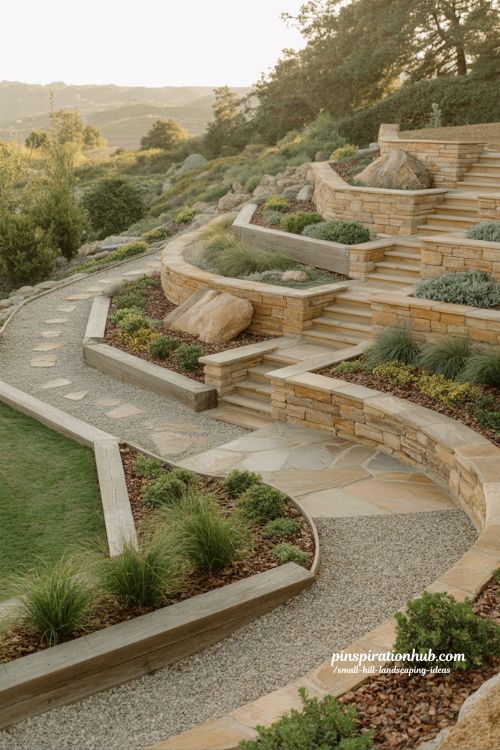
There’s a moment every hillside homeowner knows well — you look out at that slope in your backyard and wonder what on earth to do with it. Mowing it is a nightmare. Leaving it bare feels like a waste. But here’s the thing: a hill isn’t a problem. It’s one of the best landscape opportunities you’ll ever have. With the right small hill landscaping ideas, that slope becomes the most talked-about feature of your entire yard. These 17 ideas cover every slope, every budget, and every style — so you can stop dreading your hill and start designing it.
– A gentle slope needs different solutions than a steep bank — we cover both.
– Low-maintenance options exist at every price point, from mulch and groundcover to stone and boulders.
– Hardscaping like retaining walls and steps adds structure and long-term value to any hillside.
Why Sloped Yards Deserve More Credit
Flat yards are easy, sure. But easy isn’t always interesting. A hillside gives your landscape natural elevation changes, built-in drainage direction, and layers that flat yards have to fake with raised beds. The challenge is real — erosion control, water runoff, and mowing difficulty are genuine headaches — but every one of those challenges has a creative solution. Whether you’re working with a soft rise in the front yard or a steep drop out back, the ideas below will meet you where your yard actually is.
17 Small Hill Landscaping Ideas for Every Yard and Budget
1. Split the Hillside Bed With a Central Path
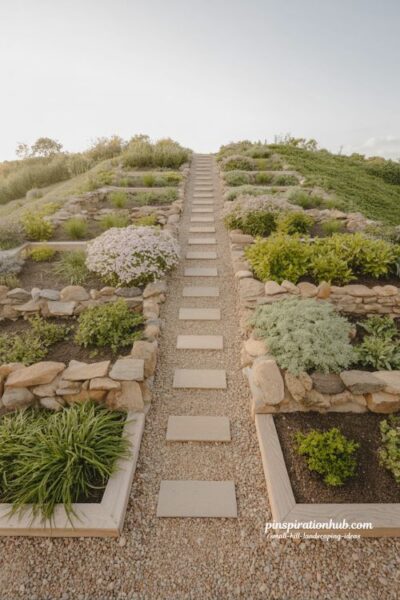
A large hillside bed can feel overwhelming to maintain — and near-impossible to reach in the middle without trampling everything. Splitting it in two with a stone or gravel path changes everything. You get clean visual structure, easy access for weeding and mulching, and a natural walkway built right into the slope. This one small change immediately makes a hillside look intentional and designed rather than overgrown and neglected.
– Choose low-maintenance plants like ornamental grasses or creeping phlox for both sides.
– Use flat stepping stones for the path so it doesn’t wash out in heavy rain.
– Keep the path wide enough for a wheelbarrow — your future self will thank you.
2. Build Timber Terraces on a Budget
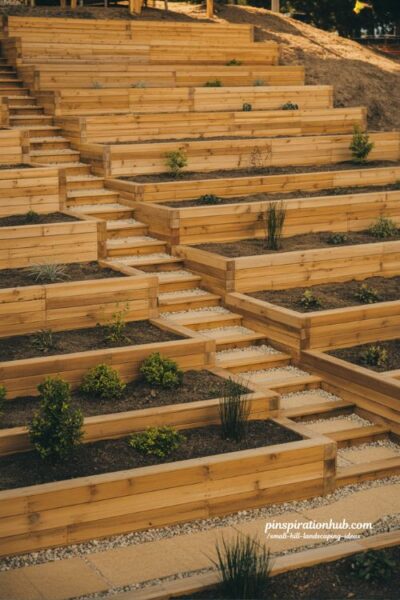
Terracing is the classic approach to a sloped yard, and timber makes it surprisingly affordable. Stacked timber retaining walls divide the hillside into flat planting zones, so you can actually garden on a slope without everything rolling downhill. The look is warm and organic, especially once plants fill in. Stone will outlast timber and deliver a more refined finish, but treated timber gets you the same structural benefit at a fraction of the cost.
– Use pressure-treated lumber rated for ground contact to extend the lifespan.
– Backfill each terrace with quality topsoil before planting.
– Stagger the timber joints when stacking for added strength and stability.
3. Anchor the Slope With Big Boulders
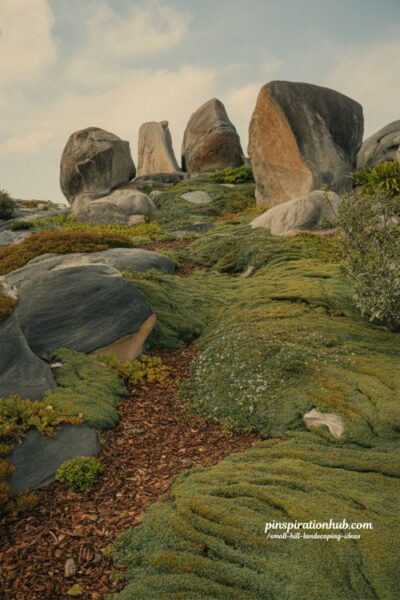
Boulders are the unsung heroes of hillside landscaping. They need zero watering, zero pruning, and zero seasonal upkeep — yet they add instant drama and weight to any slope. Scatter a few large ones throughout a groundcover planting and the hillside suddenly looks curated. Plant roots wrap around the stones over time, and the boulders help hold soil in place. Permanent sculpture that doubles as erosion control — that’s hard to beat.
– Odd numbers of boulders (3, 5, 7) always look more natural than even groupings.
– Bury about one-third of each boulder underground so it looks settled, not dropped.
– Mix boulder sizes for a more naturalistic, less uniform feel across the hillside.
4. Plant a Trailing Groundcover That Does the Work for You

If low-maintenance is your top priority, trailing groundcovers are your answer. Plants like creeping juniper, vinca, or crown vetch spread naturally across a hillside, suppress weeds, and hold soil with their roots — all without much input from you. The first season requires some watering while things establish, but after that, most groundcovers are genuinely hands-off. For shaded slopes, try pachysandra. For sunny banks, ice plant or creeping thyme are beautiful and tough.
– Research whether your chosen groundcover is invasive in your region before planting.
– Plant densely to close gaps quickly and prevent weeds from getting established early.
– Add mulch between plants in year one to retain moisture and suppress weed growth.
5. Layer Fieldstones to Stop Mulch From Washing Away
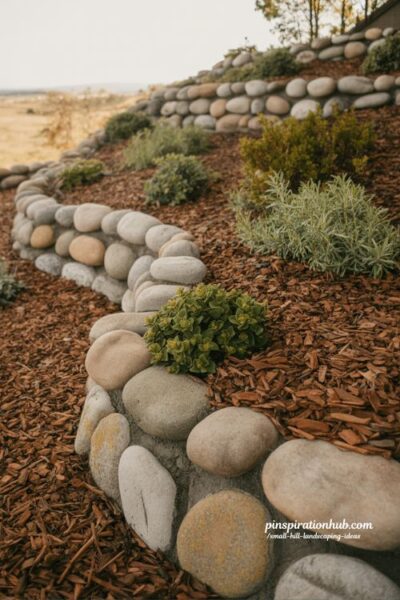
If you’ve mulched a hillside only to watch it all slide downhill in the first rain, fieldstones are your fix. A single row of rounded fieldstones along the natural curve of the slope acts as a natural dam for mulch without looking like an ugly barrier. Build up two or three courses where the grade is steepest. The stones weather beautifully over time, developing moss and patina that makes them look completely at home.
– Choose rounded river rocks or fieldstones over sharp angular stones for a natural look.
– Lay stones on a slight backward angle so water drains into the bed, not over the wall.
– Tuck small trailing plants between stones for added softness and coverage.
6. Add a Natural Water Feature That Works With Gravity
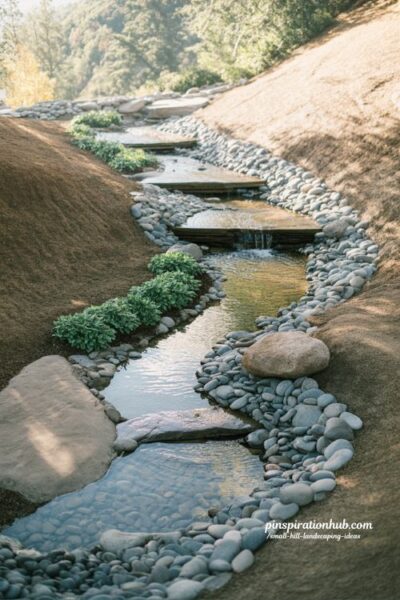
Water already wants to flow downhill — so use that instead of fighting it. A dry creek bed or simple waterfall requires less earthwork than almost any other water feature because the grade already exists. Line a natural swale with river rock to serve as both drainage and decoration. For more drama, add a recirculating pump and let the slope create a genuine backyard waterfall that looks like it was always meant to be there.
– Dry creek beds handle stormwater runoff beautifully and need zero ongoing maintenance.
– Use varying sizes of river rock — large anchors mixed with smaller fill — for a realistic look.
– Curve the creek’s path naturally rather than running it in a straight line downhill.
7. Mix Plants for Color, Height, and Disease Resistance
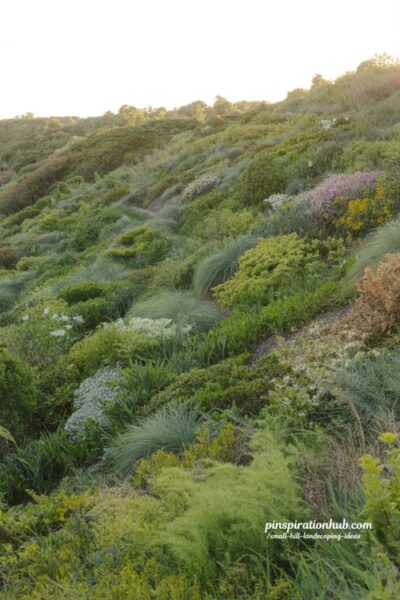
One plant species across an entire hillside is a risk. If disease or drought hits, you lose everything. Mixing species protects you while creating a far more interesting landscape. Combine low groundcovers with mid-height perennials and a few taller ornamental grasses for layered texture. Think in drifts — clusters of each plant that flow into each other rather than rigid rows. On a hillside, this kind of planting looks effortlessly wild and alive.
– Mix bloom times so something is always flowering from spring through fall.
– Combine plants with different leaf textures — fine grasses, broad hostas, needle-like conifers.
– Group plants with similar water needs together to simplify irrigation across the slope.
8. Install Stone Slab Steps for a Naturalistic Look
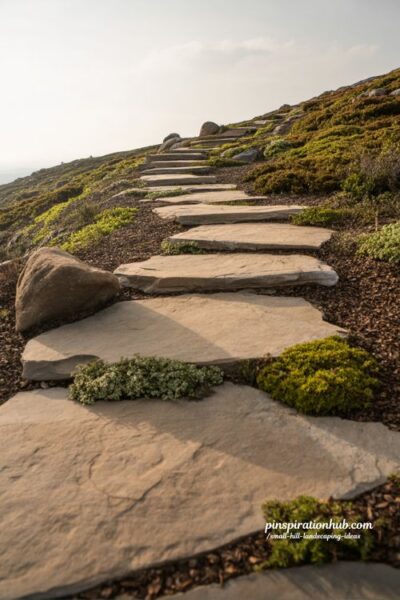
Long flat slabs of stone make some of the most beautiful hillside steps you can build — wide, deep, and chunky in a way that standard brick or poured concrete simply can’t match. Stack them slightly into the hillside with boulders tucked alongside for a look that feels like a garden discovery rather than a constructed staircase. This works especially well on gentle slopes where each step only needs to rise a few inches.
– Leave gaps between slabs and plant creeping thyme or moss to soften the edges.
– Aim for a rise of 4–6 inches and a tread depth of at least 14 inches for comfort.
– Use the largest, flattest stones available — thin slabs can shift or crack under foot traffic.
9. Create a Switchback Path for a Gentle, Walkable Grade
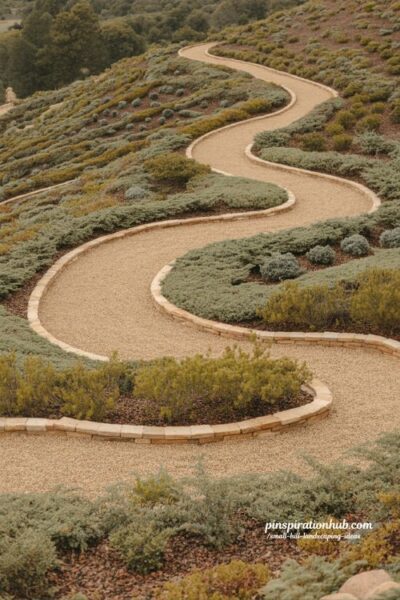
Stairs aren’t the only way up a hill. A switchback path — one that zigzags back and forth across the slope — lets you walk a steep grade with barely any effort because the path dramatically reduces the incline. The more curves you build in, the softer the walking grade. Gravel, decomposed granite, or stepping stones all work well for the surface. As a bonus, switchback curves create natural planting pockets between each bend.
– Edge the path with low stones or steel lawn edging to keep gravel in place over time.
– Plant the inner curves of each switchback with low shrubs or groundcovers for definition.
– Keep the path at least 36 inches wide so two people can pass comfortably side by side.
10. Build a Classic Retaining Wall With Modern Flair
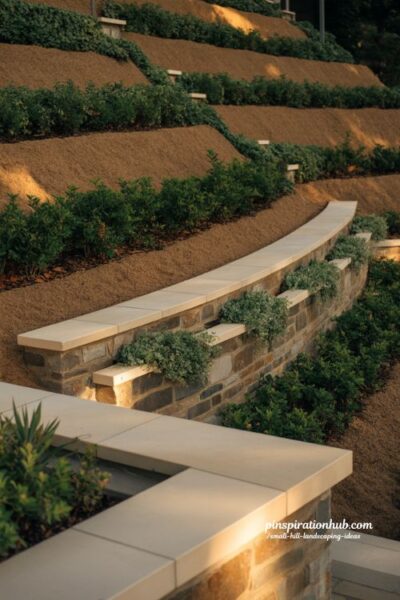
For steeper banks or abrupt grade changes, a retaining wall is often the most practical solution — and it doesn’t have to look purely functional. Modern walls use natural stone, concrete block, or corten steel for a look that’s as much art as engineering. Integrated planting pockets, built-in seating caps, and uplighting turn a structural necessity into a genuine design feature. They also create flat usable space behind them, which is a great long-term investment.
– Always install proper drainage behind retaining walls to prevent pressure buildup over time.
– A wall over 3 feet tall typically requires a permit — check your local codes before building.
– Cap the wall with a flat stone or timber that complements your home’s exterior materials.
11. Turn Your Hillside Into a Prairie-Inspired Planting
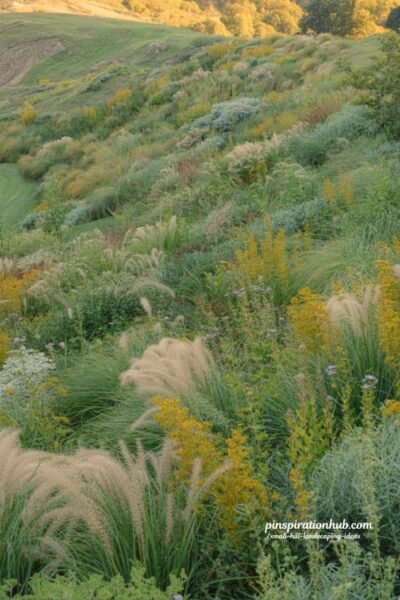
Prairie-style planting — ornamental grasses, native wildflowers, and perennials left standing through winter — is one of the most naturalistic approaches to a hillside. Plants self-seed and spread, filling gaps without help from you. The look shifts beautifully through the seasons: airy and colorful in summer, golden and architectural through fall and winter, cut back fresh each spring. It’s a style that rewards patience and genuinely gets better every single year.
– Cut everything back in early spring before new growth emerges from the soil.
– Choose native species suited to your climate zone for the most self-sufficient planting.
– Leave seed heads standing through winter — they feed birds and look beautiful in frost.
12. Break Up the Slope With Lateral Grass Paths
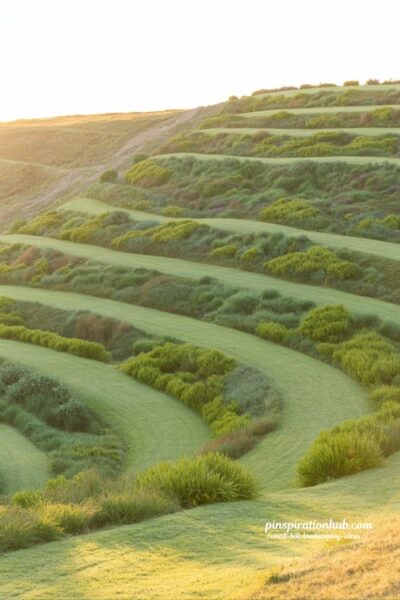
Not every hillside solution requires hardscaping. Mowing a few horizontal paths across the slope creates structure, access, and visual rhythm without spending a dollar. Lateral grass paths break a large hillside bed into horizontal bands, making the planting look intentional rather than wild. They also give you somewhere to walk while tending plants, and allow the eye to read the hillside in layers rather than as one overwhelming, undifferentiated mass of green.
– Keep grass paths wide enough to mow easily — at least 18 to 24 inches minimum width.
– Edge the paths cleanly against adjacent planting beds for a crisp, maintained appearance.
– Use the path zones to gradually expand planting areas over time as your budget allows.
13. Add Planter Boxes for Flowers or Vegetables
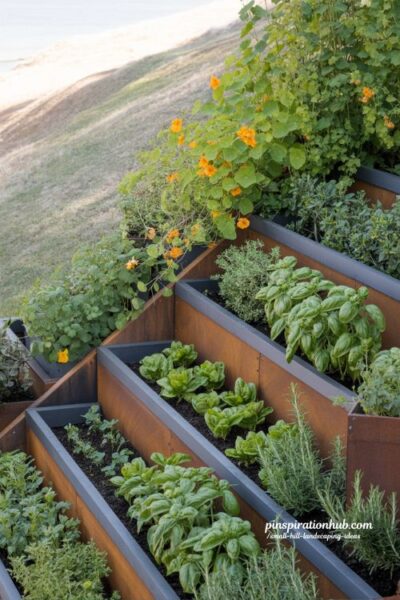
Built-in planter boxes on a hillside turn unusable slope into productive growing area. Tiered boxes filled with vegetables, herbs, or cascading flowers bring a kitchen or cutting garden to life on a slope. Custom-built boxes can follow the exact contours of your hillside and create a terraced effect without a full stone retaining wall commitment. Dark wood or corten steel both look sharp against lush plantings and weather beautifully over time.
– Line planter boxes with landscape fabric before filling to extend their lifespan significantly.
– Use a rich, well-draining potting mix rather than native soil for best plant results.
– Cascade trailing plants like nasturtium or sweet potato vine over the front edges for fullness.
14. Design a Rock Garden That Thrives With Zero Fuss
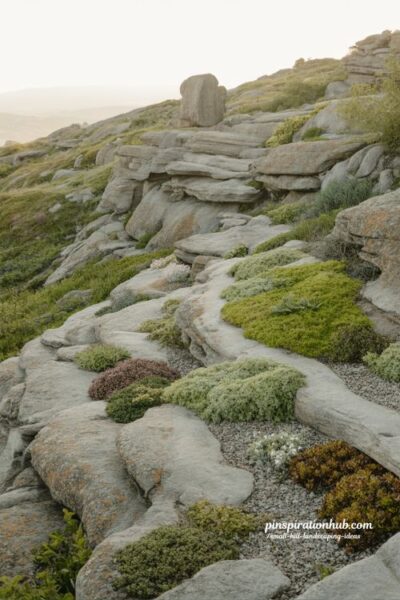
A rock garden on a hillside isn’t just low-maintenance — it can be genuinely stunning. The slope provides exactly the sharp drainage that alpine and drought-tolerant plants need, so they thrive where they’d struggle in flat ground. Layer rocks of different sizes with soil pockets between them, then plant sedums, thyme, and phlox in the gaps. A few seasons in, the plants fill every crevice and the whole thing looks completely natural.
– Choose rocks from the same local stone family for a cohesive, naturalistic composition.
– Plant in fall or early spring so new plants establish before facing summer heat stress.
– Use gravel or crushed stone as mulch around plants to improve drainage and suppress weeds.
15. Create a Raised Patio With a Hilltop View
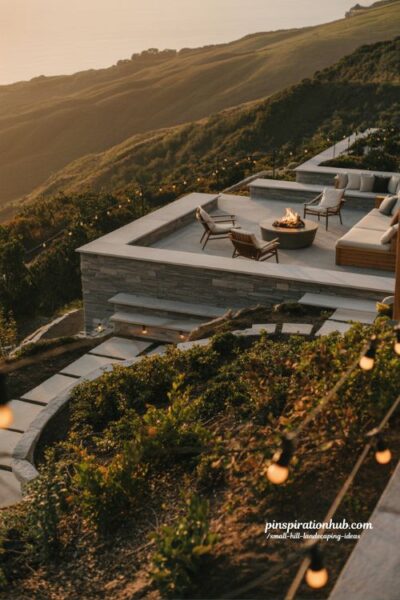
A hill gives you something flat yards can’t buy: elevation. A raised patio built into or on top of a hillside creates an outdoor living space with a real view — a destination at the top of your yard. Add a fire pit, comfortable chairs, and string lights and you’ve created an entirely new room outside. The hillside below can be landscaped with any combination of the other ideas here, framing the view beautifully from above.
– Position the patio to face your best view — garden, water, or the direction of the sunset.
– Use the retaining wall needed to build the patio as a built-in seat wall for extra seating.
– Add low-voltage path lighting leading up to the patio for safety and evening atmosphere.
16. Use Mulch Glue to Keep Beds Looking Fresh
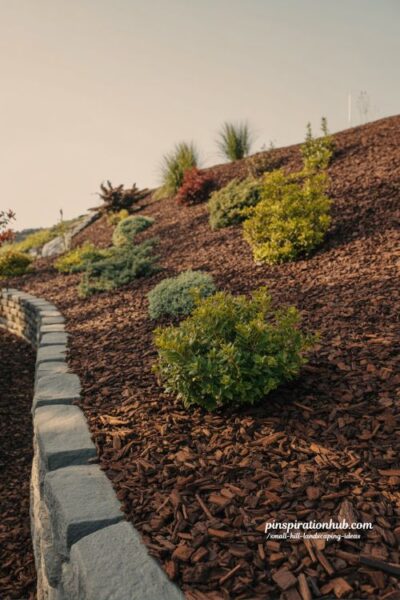
Fresh mulch on a hillside looks incredible for about 24 hours — until it rains. If you’ve avoided mulching your hillside beds for this reason, mulch glue is worth knowing about. It’s a spray-on adhesive that bonds mulch in place even on steep slopes, without affecting drainage or plant health. It’s not permanent — you’ll reapply as needed — but it’s a simple way to keep that clean, freshly mulched look through heavy rainfall.
– Apply mulch glue on a dry day and allow full drying time before any expected rain.
– Dark-colored mulch makes plant greens pop and absorbs warmth to boost early spring growth.
– Pair mulch glue with a stone edging border for maximum containment on the steepest slopes.
17. Work in Zones for the Steepest Slopes
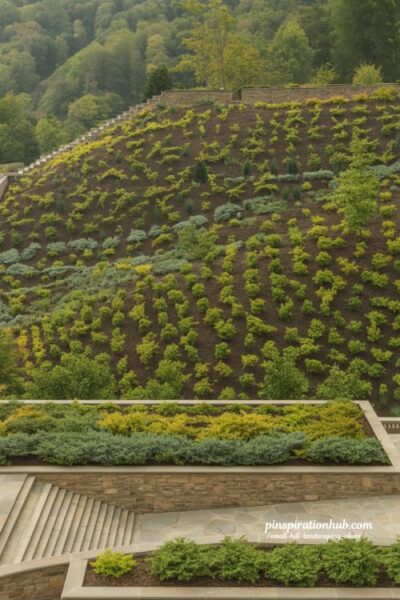
For truly steep hillsides, stop thinking of it as one project and start treating it as several. Divide the slope into zones — an upper terrace, a mid-level planted bank, a lower retaining wall — and design each zone to do one specific thing. This makes steep slopes manageable, buildable in phases, and visually coherent. Each zone becomes its own mini-landscape that connects to the others through consistent materials and plant choices across the whole hillside.
– Use consistent stone or plant species across all zones to tie the hillside together visually.
– Tackle the most erosion-prone or dangerous zone first, before working on aesthetics.
– Build one zone per season if budget is tight — a phased hillside still looks completely intentional.
FAQ
What are the best plants for small hill landscaping ideas on a slope?
Low-growing, spreading plants work best for hillside planting. Creeping juniper, vinca, ornamental grasses, creeping phlox, and native wildflowers all perform beautifully and hold soil effectively. For shaded slopes, try hostas, pachysandra, or ferns. The most important factor is choosing species suited to your climate zone and the sun exposure on your specific hill — a plant that thrives in full sun will struggle on a shaded north-facing bank.
How do I stop soil erosion on a hillside?
The fastest fix for erosion is root coverage — groundcovers, grasses, or low shrubs planted densely across the slope. For immediate stabilization, layer fieldstones or install a retaining wall to physically hold soil in place. Mulch helps, but use it with stone edging or mulch glue to keep it from washing away. For steep slopes, combining a retaining wall at the base with deep-rooted plantings above gives you the most complete and lasting erosion protection.
Can I plant grass on a sloped yard?
You can, with some caveats. Most riding lawnmower manufacturers advise against mowing slopes steeper than about 15 degrees, so mowing becomes difficult or unsafe beyond that point. For gentle slopes, choose a grass seed variety specifically labeled for use on slopes, or use sod for faster establishment and better initial erosion resistance. For steeper banks, groundcovers are a much more practical long-term solution than turf grass that you’ll struggle to maintain.
What is the cheapest small hill landscaping idea?
Trailing groundcover planting is generally the most budget-friendly option. You can start with a small number of plants, let them spread naturally, and add more over time as your budget allows. A prairie-style wildflower and grass planting is similarly affordable — seed costs very little and once established, the planting largely maintains itself. Layering fieldstones to contain mulch is another low-cost way to add structure and stop erosion without a major investment in hardscaping.
Do I need a retaining wall for a gentle slope?
Not necessarily. Gentle slopes respond well to groundcovers, prairie plantings, and boulder anchoring without any formal retaining wall. Walls become most useful — and sometimes structurally necessary — when you have an abrupt grade change, a very steep bank, or a hillside that’s actively eroding. For gentle slopes, the cost of a retaining wall often isn’t justified by the problem it’s solving. Start with plants and rocks, and save the wall budget for where it’s truly needed.
How do I add steps to a hillside garden?
For a naturalistic look, stone slab steps built directly into the hillside are the best option — wide, deep treads with boulders alongside feel like garden features rather than construction. For a more formal approach, poured concrete or cut stone block steps are durable and clean. A switchback path made from gravel or stepping stones is the easiest DIY option if you want to avoid stairs entirely. Aim for a rise of no more than 6 inches per step for safe, comfortable climbing.